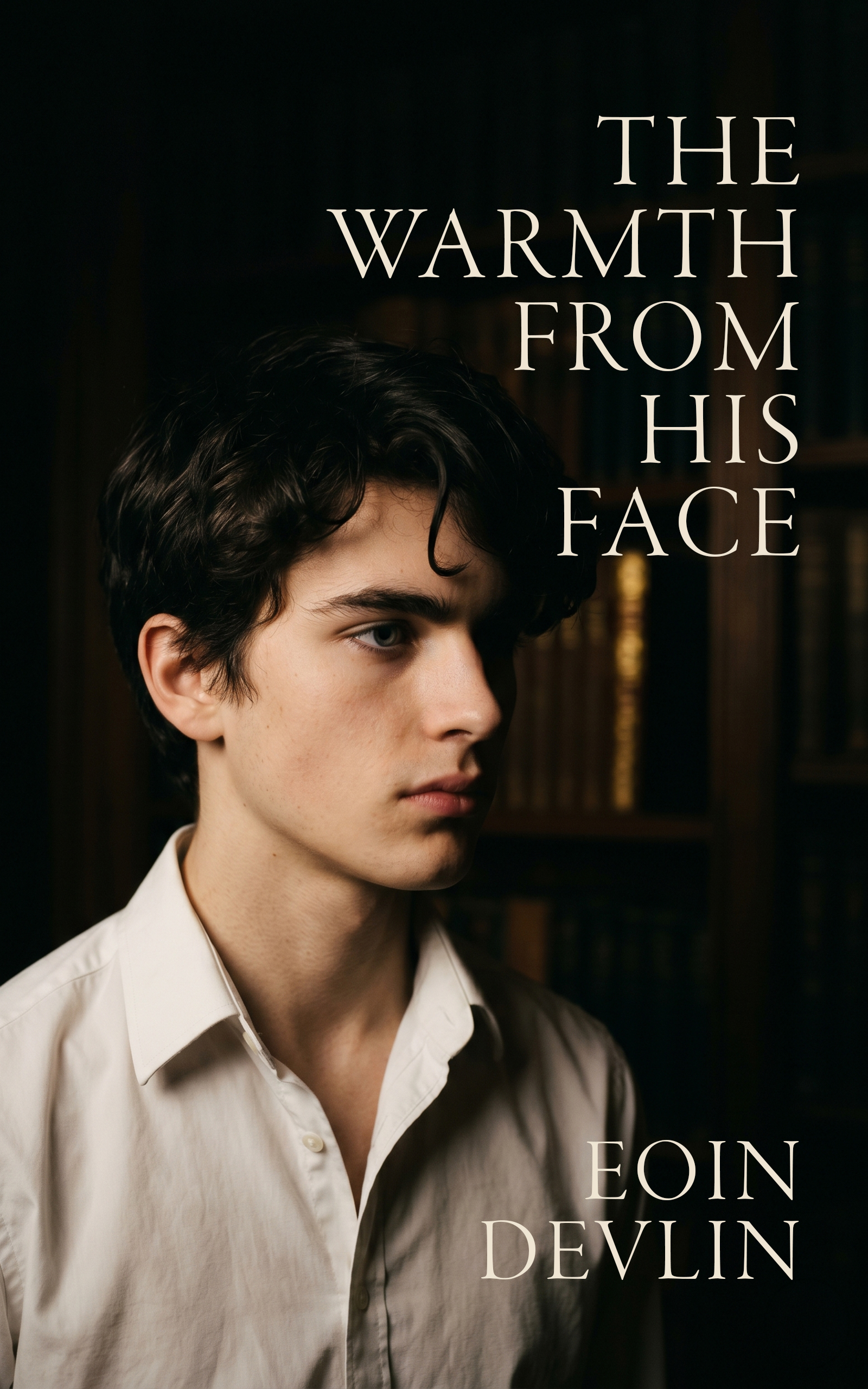
The Warmth From His Face
In September 1948, after a beating at the Christian Brothers leaves him bleeding on a doorstep in Dublin, fourteen-year-old Thomas Hennessy is sent to an English public school. In his second week of Latin the boy at the next desk — Sebastian Cavendish, beautiful, aristocratic, oblivious — quietly corrects an error Thomas has made, without looking up. Thomas will spend the better part of the next seven years living downstream of what that moment set in motion.
Over four years he watches Sebastian, lives on fragments of his attention, and gradually stops praying in the Latin his father had taught him. In May 1952, on his father's signed consent, he is received into the Anglican Church — a deliberate break with the Catholic Church of his birth, undertaken for reasons he cannot, at eighteen, fully sort. Two years later, in his third year reading Greats at Oxford, he walks at last to Sebastian's rooms at Christ Church and asks for what he has wanted since he was a schoolboy. He is given it. The having does not end the wanting.
The Warmth From His Face is a novel about the quiet damage one person can do in another's life simply by being what he is — the kind that admits no agent and asks no apology — and about the disproportion between a young man's life and the small ordinary moment that decides it. Set across a decade in postwar Dublin, an English public school in the rationing years, and Oxford in the mid-1950s, and written in a register of austere observation, it follows Thomas through the formation, the long silence, and the consummation that becomes, in the end, the test of an argument his body has been making against a mind that has been refusing to listen.
An excerpt
Thomas Hennessy arrived at the station on the first afternoon of Michaelmas 1951 with the same trunk he had brought four years earlier from Dublin, the brass corners dulled now, his initials still legible on the lid in the paint his father had applied the night before he first left Ballsbridge in September 1948. The porter took it without looking at him. The walk up from the station was three-quarters of a mile along a road he could have described with his eyes closed — the flint wall on the left, the rookery in the elms, the gate into the cricket field where in summer the grass was cut in pale stripes and in October smelt of rotting leaves and the smoke of the groundsman's fire — a road in a country that was not his, and that he had not, in four years, mistaken for his.
For readers of Alan Hollinghurst's The Folding Star, Colm Tóibín's The Master, André Aciman's Call Me By Your Name, and Kazuo Ishiguro's The Remains of the Day.