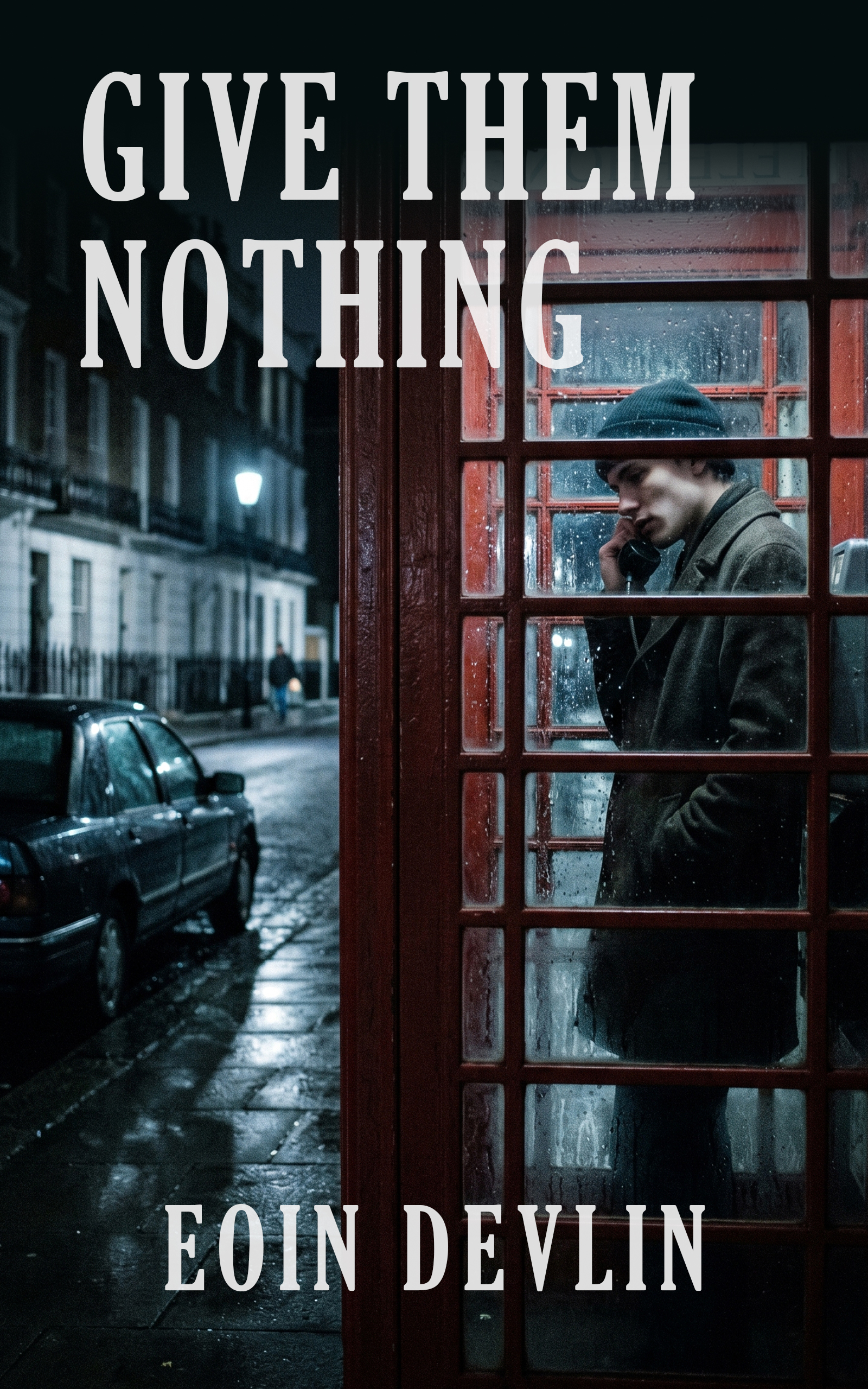
Give Them Nothing
A Novel of Love and the Troubles
The day Niall Loughran buried his brother was one of the worst of his life. It was 1985; he was sixteen, and the war in the North of Ireland had already taken more from his family than it would ever give back. Michael — a volunteer, sent out and lost — and at the graveside, with the British helicopters low over the crowd, Niall learned the thing that would shape the rest of his life: how to stand still, feel everything, and give nothing away.
What the British never guessed — and what almost no one in the republican movement was ever allowed to know — was what that young man would later become. To British intelligence he was a frightened informer, turned through the leverage of his private life: compromised, handled, contained, and therefore safe to confide in. They had it exactly backwards. He was loyal to the last, and the thing they believed they held over him was the thing he had made his weapon. His work was patient, intimate, all but invisible — moving in and out of the lives of those close to the heart of British power, becoming to each of them the thing they had always wanted and never let themselves have.
He was good at it because he had been broken in exactly the way the work required. Then, in the first fragile months of an IRA ceasefire that seemed it might finally hold, he met the one man he should never have touched — an adversary whose job was to catch people like him, and who, knowing only half of what Niall was, came to love him. Their affair ran the length of that brief peace; and when the peace shattered in the bombing of Canary Wharf, the order came to destroy the man Niall loved.
Give Them Nothing is the account he sets down years later, in exile in Boston, for the one person who might read it and not turn away — the sister he has lied to all his life. It is a novel about waste: of a war, of a life, of a man's whole capacity for love, given over to a cause that would deny he ever existed. And it is about the one thing that waste could not touch. Spare and devastating, tender and merciless, it is a conflict novel and a love story and a spy novel like no other — quiet where the others are loud, and unbearable where they are merely tense.
An excerpt
The helicopter had been up since before it was light. It was the thing he woke to, for three days after only sleeping for about an hour each night, the thundering sound coming and going over the rooftops in a slow circling that never arrived and never left; and lying in the dark with the other bed empty across the room he listened to it as he would have to rain, and he decided it was something there was no point having an opinion about today.
Downstairs the house was already going. He could hear the women in the kitchen, the low pitch of women who had been up since five, the tick of the immersion, a man clearing his throat who was not his father. The good room below was full of his brother. They had brought Michael home on the Wednesday, and at the foot of the coffin, folded small, a tricolour that belonged to nobody in the house.
For readers of John le Carré's The Spy Who Came in from the Cold, Anna Burns's Milkman, and Alan Hollinghurst's The Line of Beauty.